Step Up, Save CO₂: The Climate Challenge
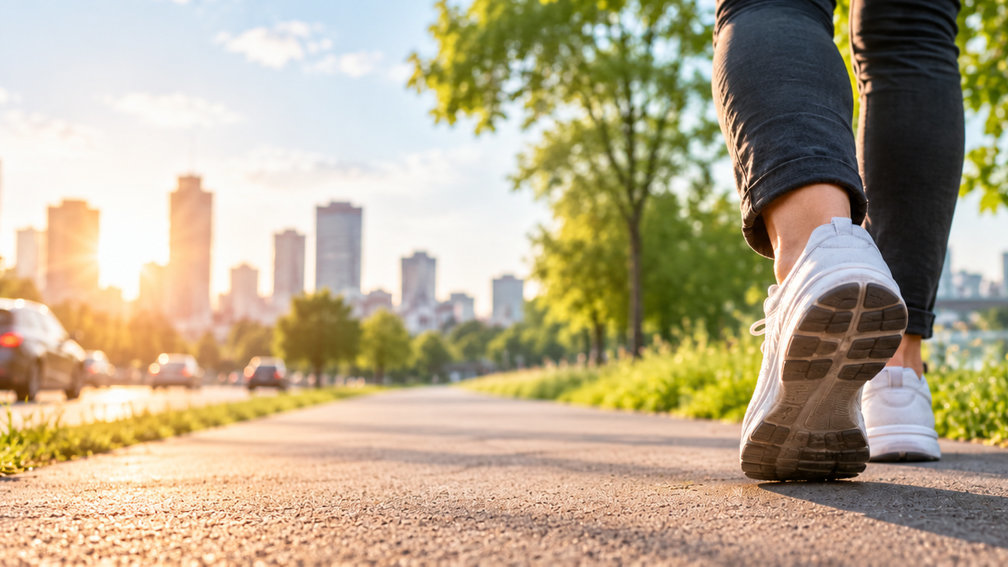
Can you save CO₂ by walking? Yes – when walking replaces car journeys. A step challenge can help companies motivate employees to be more active while also encouraging climate-friendly mobility. This is how Dasfitnesswunder combines workplace health promotion with sustainability and climate action.
Can walking really save CO₂?
Every step is good for your health – but not every step automatically saves CO₂.
For example, going for an extra walk in the evening increases your daily activity. However, this does not directly result in CO₂ savings.
The situation is different when journeys that would normally be made by car are deliberately made on foot.
Walking to the bakery, supermarket, train station or lunch – or even walking part of the way to work: especially for short journeys, there are many opportunities in everyday life to leave the car at home.
This is exactly where a step challenge with a focus on sustainability can make a difference.
From a step challenge to a climate challenge
A traditional step challenge motivates employees to be more active in their everyday lives. When the initiative is combined with sustainable mobility, it becomes a climate challenge for companies.
For example, the challenge could be:
„Collect steps together – and try to replace as many short car journeys as possible with journeys on foot.“
This gives the challenge an additional dimension. Alongside the number of steps, the focus is on how physical activity can be meaningfully integrated into a more sustainable everyday lifestyle.
Employees are therefore not only doing something for their own physical activity, but are also becoming more aware of their own mobility habits.
Why short car journeys are particularly interesting
Many everyday journeys are surprisingly short.
A nearby appointment, a trip to the bakery, the journey to lunch or a quick errand are often made by car.
A step challenge provides a playful incentive to question these habits:
Could I walk this journey today?
The aim is not to avoid driving altogether. For many commutes and business appointments, a car is necessary.
Rather, it is about those journeys where an alternative is realistic.
These small decisions can add up when large numbers of people take part.
How can CO₂ savings be calculated?
A serious climate challenge requires an important distinction:
Collected steps or kilometres walked must not automatically be equated with kilometres saved by avoiding car journeys.
After all, someone who walks 100 kilometres during a challenge would not necessarily have driven those 100 kilometres by car. For a transparent and reliable CO₂ calculation, only journeys where motorised transport was actually replaced should therefore be taken into account.
In simplified terms, the savings can be calculated according to the following logic:
avoided car kilometres × CO₂ emissions per kilometre = avoided CO₂ emissions
For example:
If participants in a company challenge collectively walk 5,000 kilometres that would otherwise actually have been driven by car, a calculated CO₂ saving can be determined based on a previously defined and transparently stated emissions factor. This keeps the communication clear and avoids exaggerated sustainability claims.
Millions of steps make sustainability visible
The particular strength of a step challenge lies in the sense of community. A single additional walk may seem insignificant at first. But when hundreds or thousands of employees take part at the same time, the numbers can become impressive.
Individual steps become millions of steps.
Short walks become thousands of kilometres.
And many small decisions become a shared initiative for more physical activity and more sustainable mobility.
Companies can communicate the results of their challenge, for example, like this:
„Together, we collected 25 million steps.“
„During the challenge, our employees walked 18,000 kilometres.“
„Of these, 3,500 kilometres were deliberately walked instead of driven by car.“
Only the final figure can then be used to calculate a meaningful CO₂ saving.
Climate action that actively involves employees
Many of a company’s sustainability measures take place behind the scenes.
Solar installations, energy-efficient renovations, more climate-friendly procurement or the optimisation of production processes can have a major impact. However, employees do not always experience these measures directly.
A climate-focused step challenge works differently.
Everyone can take part.
Everyone can see their own steps.
Teams can achieve goals together.
And the entire workforce can see how many individual activities can come together to create a major shared result.
This makes sustainability not just something that is communicated, but something that can be experienced.
Combining sustainability with workplace health promotion
The combination is particularly interesting for companies because a step challenge can support several objectives at the same time. It promotes everyday physical activity, motivates employees to adopt a more active lifestyle, strengthens team spirit and can simultaneously raise awareness of sustainable mobility.
This creates a connection between workplace health management, employee engagement and sustainability. A one-off initiative can even become a recurring format – for example, an annual health and sustainability challenge.
A climate challenge doesn't have to be complicated
One major advantage of a step challenge is its low barrier to entry.
Employees do not need to be competitive athletes. The aim is not to see who can run a marathon or achieve extreme step counts every day.
- Even small changes count:
- Walk to the train station.
- Take the stairs instead of the lift.
- Go for a walk during your lunch break.
- Run short errands without the car.
- Have a „walking meeting“.
- Deliberately leave the car at home for short journeys.
It is precisely this simplicity that makes it possible to involve very different groups of employees in a shared initiative.
Ideas for a sustainable step challenge
Companies can expand the basic principle of a step challenge with additional activities. One option, for example, is to set a shared company-wide goal:
50 million steps for climate action.
If the goal is reached, the company could support a regional environmental or social project.
Team goals are another option. Different locations, branches or departments can collect steps together, without putting the focus exclusively on the fittest participants.
Specific action days can also be incorporated:
„Leave the car at home today.“
„Walk to work.“
„Walking Wednesday.“
„10,000 extra steps for the team.“
This keeps the challenge varied and ensures that sustainability remains visible throughout the campaign.
From kilometres to engaging stories
Large numbers alone are often difficult to visualise.
That is why the results of a step challenge can be translated into relatable comparisons:
How many times could all participants have walked across Germany together?
How many times does the total distance correspond to the distance from Cologne to Berlin?
How many times around the world would the total number of kilometres represent?
Comparisons like these attract attention and are ideal for internal communications, intranets, newsletters or closing events.
For climate action, however, the same principle applies here:
The total distance walked should be presented separately from the motorised kilometres actually avoided.
This ensures transparency and credibility.
Dasfitnesswunder: Move together and make a difference together
With Dasfitnesswunder, companies, organisations and municipalities can run their own digital step challenge.
Participants collect their daily steps using smartphones and compatible fitness trackers or wearables. This turns individual activities into a shared competition or community experience.
The challenge can focus on different themes – from traditional workplace health promotion and team building to employee motivation, sustainability and climate-friendly mobility.
This is how a step challenge can become a climate challenge that brings two important topics together:
Healthy people and a more sustainable future.
Conclusion: Climate action can start with a single step
A single journey made on foot will not change the world.
But many small changes can have a significant impact – especially when hundreds or thousands of people take part together.
A step challenge for companies therefore offers a simple way to motivate employees to be more active while also raising awareness of sustainable mobility.
The key idea is:
Not every step saves CO₂. But every journey deliberately made on foot instead of by car can make a contribution.
With Dasfitnesswunder, you can see what people can achieve together.
Start your own climate step challenge
Would you like to combine health, physical activity and sustainability in your company?
With Dasfitnesswunder, you can create an individual step challenge for your employees – optionally with a particular focus on sustainability and climate-friendly mobility.
Turn movement into a shared mission. Get in touch with us and start your next step challenge.